Türkiye, The Balkans and The Natural Position Concept
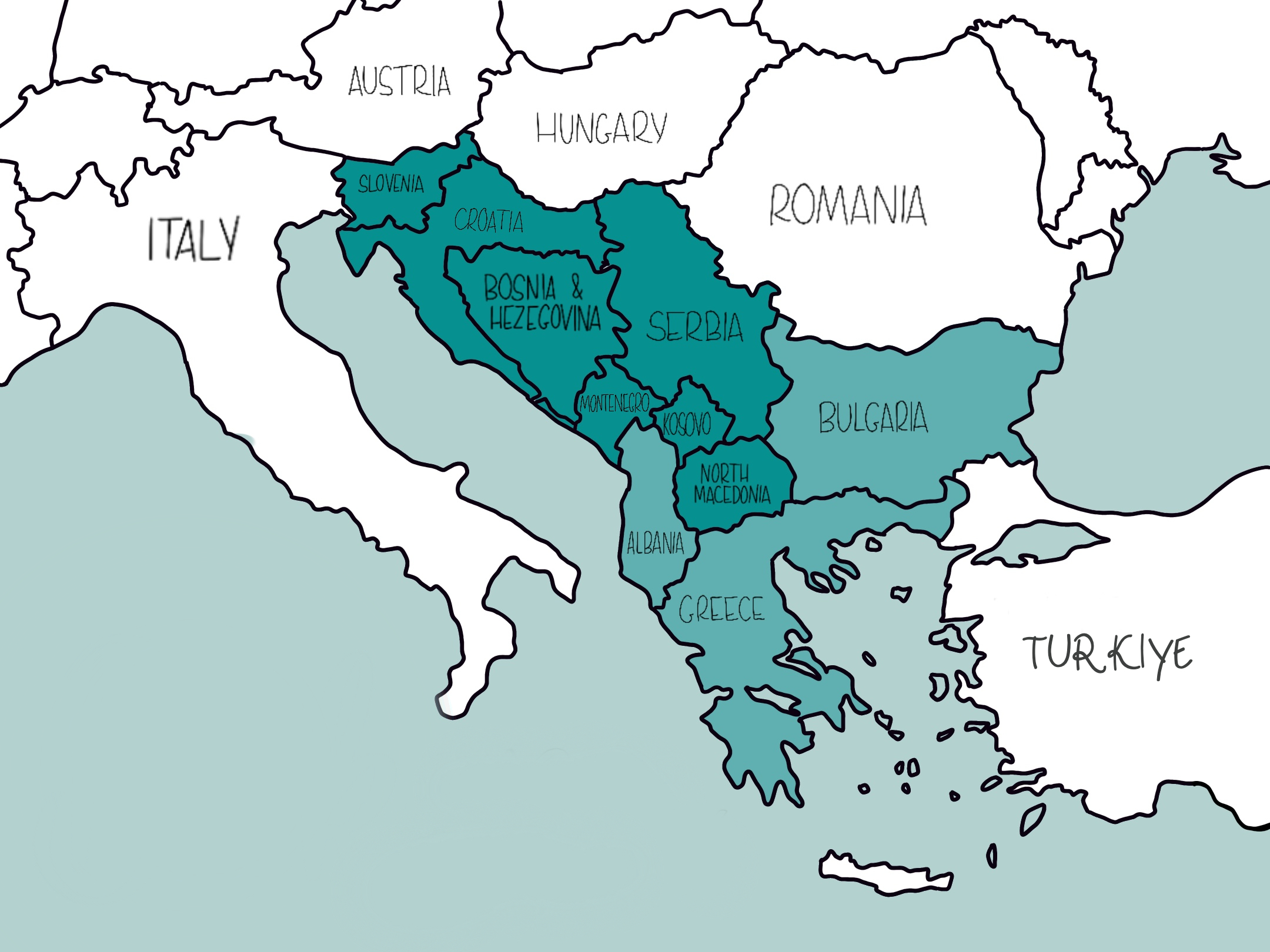
There is a profound relationship between the state of Türkiye and the Balkan region, considering their historical, political, social, and cultural interdependencies spanning centuries. Türkiye’s pivotal role is evident in the whole region of the Balkans, instigated from its modern statehood, up to today. As the successor of the Ottoman empire, Türkiye holds a great platform that helps further the process of engagement and justifies deeply its involvement and position in the Balkans. By examining the historical and common heritage of the Balkan states and Türkiye, we can easily conclude that Türkiye holds a prominent position in the region.
However, it urgently needs to restore and re-adjust its policies to capitalize on and fill the newly created vacuum in the Balkans, considering current global political shifts.
The Turkish involvement in the Balkans as an important (f) actor with its complex role can be analyzed from a variety of theoretical perspectives, having in mind the theory of regionalism, neo-colonialism, neo-Ottomanism and soft power theory and others. However, the most suitable is the natural position concept, introduced in a academic paper which I have published recently, that justifies Türkiye’s involvement and further more gives space for deeper political, social and economic interdependency between the states of the Balkan region and Türkiye.
The concept of Natural Position encompasses the shared heritage and/or values between a regional actor and a certain region and acknowledges this commonality as an important source of legitimacy for involvement, this commonality can be seen from a historical, social, political and/or economic context (Western Balkans, Türkiye and the concept of natural position, Ibish & Ferhad. (2023).
The historical and social context of the natural position engulfs the common heritage that was created throughout centuries and stimulates a great social capital amongst societies in the Balkan region and the state of Türkiye. This bond, to a certain degree shows that even the soft power tooling is unnecessary as the common heritage helped this bond to exist, e.g the case of North Macedonia. The cultural, religious and ethnic ties as well as the pan-Balkan diaspora in Türkiye boost the social context and via their social capital through variety of networks, NGOs and other associations open deeply the ground for active involvement in the Balkans.
The economic context clearly depicts the high development of the economic interdependency between Türkiye and the Balkans states, not only from the Foreign Direct Investments (FDIs) and export perspectives on both sides, but also from the shared know how that companies and states intrinsically provide in order to achieve the best from a cooperation via competition model. The sector of banking, agriculture, tourism, health and security industry has profoundly developed in Türkiye and as such can help and support the states of the Balkan region. Türkiye is a non-petro-dollar economy but still advanced its economic platforms via its know-how, technology and services, it clearly suits the region of Balkans in terms of guidelines and support.
Nonetheless, we have to know that Türkiye with its geography is the only state that inter-connects three continents, having that in mind, it’s the only state that can provide alternative energy resources, such as gas, and can make not only the Balkans but most of Europe less dependent on Russia.
Türkiye together with Azerbaijan are the only interlocutors of the Central Asian and Middle Eastern energy resources, thus this suits the Balkans immensely and should be deeply explored.
The natural position concept highlights the Turkish position and factorship, the lack of which is visible for other actors in the region. They either have an ideological doctrine with economical and security impetus and without a historical or social context (the case of USA via NATO which is currently experiencing a degeneration of its political values under the Trump administration. Meanwhile European actors via EU are suffering through institutional difficulties, such as asymmetrical veto powers of its members and the rise of far right movements, challenging its longstanding political values), have the cultural component without any political value and with a partial ethnic and religious interest in the region of Balkans (the case of Russia via its concept of pan Slavism), or they have only pure economic interests without any political value, and neither any cultural, historical nor geographical commonality (the case of China via Belt and Road Initiative).
Türkiye’s position, as defined by the natural position concept is more neutral and acceptable for the Balkan region (having in mind its diversity and its ethnical, religious and political heterogeneity) and supports the ground for establishing Türkiye as a middle power, possibly as a future regional hegemon that engulfs not just military power and security, but advocates strong political pluralism and power sharing, as well as social, and economic values that allow the region of the Balkans to yield with Türkiye an alliance of shared common values instead of a submissive position.
Four Periods of Türkiye’s Involvement in The Balkans
Türkiye’s involvement in the Balkans can be described into four periods and each of them depict different forms of engagement aligned with its domestic developments, regional and global contexts and given opportunities.
1. The first period of Türkiye’s engagement in the Balkans can be seen after its modern state establishment and its regional activities directed under the Kemalist doctrine “Peace at home, Peace in the world”, positioning itself as a regional actor but with the sole intention to instigate mutual cooperation, good neighborhood ties, peace and stability. Under this format, Türkiye signed various of agreements and pacts such as: Treaties of Friendship being signed with Albania (1923), Yugoslavia (1925), and treaties of reconciliation and population exchange with Greece (1929) and Bulgaria (1930) as well as the creation of the Balkan Entente 1930s as a defensive military alliance. Under this period, Türkiye was aiming to be a reginal actor without an active power role. In this period, we can also add the cold war period in which the diplomatic activities were on a very minimal formal ground but with established strong migration flows (e.g Yugoslavia and Turkiye) or dissolvement of relations and non-recognition of previous agreements (e.g Enver Hoxhas Albania and Türkiye until 1959).
2. The second period is related to the dissolution of communism and the process of political and economic transformation which encompassed the vast majority of the Balkan states, including ex-Yugoslavia and the emerging independent states following the Yugoslav wars (today, most of them are known as Western Balkan states, a term that depicts a region of states that are in a process of EU integration), Albania, Bulgaria and Romania under internal political, economic struggle and transformation. In this period the state of Türkiye showed its hard power and dedication to peace via the Bosnian War (1992-1995) and the Kosovo War (1997-1999) that were prominent cases in which it played an active role and assumed its position as a regional power and stabilizing factor, engaging in United Nations (UN) peace missions in the region (Ibish, 2016). In this period, Türkiye was actively recognizing the newly formed states, especially the case of Macedonia, today known as North Macedonia, and supporting North Macedonia’s case versus Greece over the name issue. In this regard we can also mention the recognition of the state of Kosovo in 2008 in which Türkiye demonstrated strong support and engagement for freedom, stability and security in the Balkan region. In this spirit, Türkiye’s active role in peace missions is undoubtedly evident via active participation under different formats in the cases of Bosnia and Herzegovina, Kosovo and North Macedonia. Furthermore, the support that was given to Albania versus Greece in the 90s showed a great stability factor in the regional balancing power perspective. The second period can be labeled as the period of Türkiye as an active regional stability player and a period that moved Türkiye away from the old doctrine “Peace at home, Peace in the world” into a promoter of peace while balancing and using its military capacities to protect those in need and playing the role of the regional moral agent.
After this period, Türkiye showed clearly that it’s a regional force, and an actor that will be advancing towards a more prominent visibility and with perspective to be engaged largely in the regional developments.
3. The third period is instigated intensively after 2002 and the newly created establishment. The AK Party political leadership opened the door and paid great attention to the usage of soft power mechanisms under the principles of public, cultural and economic diplomacy while launching educational mobility, cultural, religious and social networks, as well as addressing higher economic development in terms of foreign trade and foreign direct investment in many areas but especially in the banking sector, and lately, even deeper mutual cooperation and substantial sales from the Turkish military industry towards the Balkan states. This trend is set to continue, having in mind the existing frictions and disagreements between Serbia and Croatia, Serbia and Kosovo and the complex political and security status of Bosnia and Herzegovina.
Under this period, a great number of institutions have been actively launching projects and are involved in shaping the Turkish state image in a positive manner, and in places where already the social capital has existed. These institutions aim to advance the cultural and linguistic bridges to a higher degree. The involvement of TIKA, Yunus Emre Institutes, the Diyanet, Maarif Schools, YTB, Anadolu Agency, TRT Balkans, Turkish Drama Series and many other institutions and NGOs play a crucial role in addressing and creating a substantial network that shape the positive image of Türkiye within the Balkan states.
The above mentioned three periods, played a crucial role in making Türkiye a visible and an active player in the Balkans and have shaped its image as a regional power by the Balkan communities for its immense contributions in many areas.
But when it comes to its political impact, Türkiye has mostly acted in an ad hoc manner and in times of need, thus, this momentum opens a great door for a better utilization and maximization of its assets and a need for readjusting its policies towards the Balkans.
4. In my opinion, the fourth period of Türkiye’s involvement in the Balkans should be initiated as soon as possible having in mind the following momentums: (1) the urgent need of utilization and maximization of its already existing assets while establishing other substantial entities for higher political impact, thus making Türkiye not a regional power that is active only in times of need, but rather, will project Türkiye as a middle power has solid and systematic policies towards the official establishments in the Balkans, (2) the fragile local developments in terms of interstate and intrastate relations in the Balkan region and the complex role of Türkiye within these relations, (3) the global instability created due to the warfare in Ukraine and Palestine, (4) the global political shifts of USA and the radical changes under Trump’s administration which have created a power vacuum in the Balkans that needs to be urgently addressed.
Global and Regional Shifts and Türkiye’s New Approach
In this fourth period;
(1) the Turkish official actors in the Balkans can’t be isolated and stay in the sidelines, continuing the role of a neutral observer in the domestic and regional developments in the Balkans and mainly in the Western Balkan states.
(2) Türkiye should have a clear vision and policy impact towards the Balkans and assume the role of an important regional player that supports, if necessary, critiques the establishments, communicates with all political factors and brings proposals for better development and stability in the region.
(3) All its assets should be well utilized in an efficient manner and also prepare its policies via substantial entities such as establishing think tanks and institutes in the region as well cooperating with well-established university academic staff that will enable depicting the real political situation and give possibilities for change.
(4) Türkiye is a suitable factor, having in mind, the fragile situation in the Balkans which demands not only military support and balance of power, but also political stability and advocacy in power sharing and higher political culture that is deeply related to a substantial economic development and quality educational capacities.
(5) Türkiye should play a pivotal role in supporting the process of EU integration of the Western Balkan states and should substantially guide and support this region in terms of know how in agriculture and regional development. The full-fledged integration of the Western Balkans in the EU, will advance to higher efficient market economies and this will suit Türkiye immensely and would give a new source of influence, authority, and leverage with regards to the EU.
(6) No matter of the EU institutional complexity and its asymmetric approach towards the Western Balkans and Türkiye, the road towards the EU shouldn’t be discouraged, rather should be used to push the EU for new changes and use the context of Ukraine for a larger involvement and faster full-fledged integration.
(7) Having in mind the global political shifts, the latest foreign policy developments in the USA, Trump’s radical approach in shaping peace in Ukraine and Palestine and the US attitude towards its European allies, a great vacuum is created in the Balkan region and will be filled with many actors including Britain, Germany and France as well the Russian Federation and even China will act fast to get its place. In this regard, with its natural position and all its assets, Türkiye needs to take its central place and participate actively with other factors in the Balkan region assuming the role of a determined and systematic power that envisions the Balkan region in terms of stability and security, political development, EU integration and economic progress.